Frequently Asked Questions
Everything you
Everything you
wanted to ask.
Eligibility, submissions, fees, judging and the road to ISEF - every common question, in detail.
01 Eligibility
Who can participate.
Who can apply to IRIS?
Any student currently enrolled in Classes 5–12 at a government, semi-government or private school in India. Students must be of Indian origin and residing in India. There is no upper age limit beyond the class restriction.
Can I submit a project as a team?
Yes. Projects may be submitted individually or as a team of exactly two students. Teams of three or more are not accepted. Both team members must meet all eligibility criteria.
I’m a Class 12 student who applied before - can I apply again?
No. IRIS enforces a hard restriction: students who registered for a previous IRIS as a Class 12 student are not eligible to apply again. This applies regardless of whether the previous application was evaluated or shortlisted.
Do I need a teacher mentor to apply?
A single project guide (teacher or qualified mentor) is required for every project. The guide’s role is to verify the authenticity of the student’s work, not to do the research for them.
Can students from international schools in India apply?
Yes, as long as the student is of Indian origin and is currently studying at a school physically located in India - including international curricula like IB, Cambridge, etc.
Can NRIs or students studying abroad apply?
No. IRIS is open only to students currently enrolled at schools based in India. Students studying abroad are not eligible regardless of citizenship.
02 Submission
What and how to submit.
What do I need to submit?
Your submission must include three components: a project synopsis (PDF, ≤ 5 MB), a full research paper (PDF, ≤ 20 MB), and a 90-second project video (YouTube URL — unlisted or public). All submissions are made online through the IRIS website. Physical submissions are not accepted.
When is the submission window?
The registration and submission window for IRIS 2026–27 is 1 August 2026 to 13 October 2026. This is the only window — there are no extensions. Register early to receive earlier feedback on your project.
What are the word limits for each section?
Word limits apply to the synopsis sections — Abstract: 250 words (the submission portal enforces a 300-word hard cap); Introduction & Objective: 100–150 words; Innovation: 50–100 words; Methodology: 150–250 words; Results & Conclusions: 100–150 words; Acknowledgement & References: 50–100 words. The full research paper has no strict word limit (aim for roughly 10–15 pages). The project video must not exceed 90 seconds.
Can I disclose my school or city in my submission?
No. To preserve anonymous evaluation, projects must not disclose the school’s name, city or state in the project video, research paper, project report, presentation, or abstract.
How fresh does my experimental data need to be?
Experimental data cannot exceed 12 months old at the time of submission. You may extend previously started work, but the bulk of recent data should be within this window.
Can I submit multiple projects?
There is no limitation to the number of projects you can submit, whether individual or team. Each project submitted carries an individual fee.
How do I submit the project video?
Upload the video to YouTube as an unlisted or public clip (90 seconds maximum) and paste the YouTube URL into the submission portal. The portal does not accept MP4 or any direct file upload for the video.
03 Fees
Registration fees.
What is the registration fee?
The fee is ₹5,000 plus applicable taxes per project. An EWS (Economically Weaker Section) fee waiver is available with valid documentation. The fee is non-refundable except in the case of accidental duplicate payments.
How do I apply for the EWS fee waiver?
Upload a valid EWS certificate issued by a competent authority during registration. Once verified, the fee is waived for that project. Government and semi-government school students are also eligible for consideration.
Is the fee per student or per project?
Per project. A team of two pays a single registration fee.
When is the fee due?
The fee must be paid at the time of project submission - before the relevant submission window closes. Submissions without paid fee will not enter the evaluation pool.
Are there any costs for attending the National Fair?
Travel and accommodation for the National Fair are typically supported for shortlisted finalists. Specific arrangements are communicated to selected students directly.
04 Evaluation
How projects are judged.
Who evaluates the projects?
The Scientific Review Committee (SRC) - an eminent panel of scientists and domain experts from India’s premier research institutions - evaluates every submission against national and international standards.
What kind of projects does IRIS not accept?
IRIS does not accept textbook experiment replications, science essays or survey reports without personal experimentation, unsubstantiated hypotheses, claims that violate established scientific laws, toxicity studies causing vertebrate death, or display-only models without a research foundation.
What criteria are projects judged on?
Originality and innovation, scientific rigour of the methodology, quality and clarity of experimental data, depth of analysis, and the real-world significance or potential impact of the work.
When are shortlist results announced?
The SRC evaluation runs from October through November, with the National Fair shortlist typically announced in December. Selected students receive direct communication via email.
Are there any restrictions on research conduct?
Yes - strict ethical and safety standards apply. Human research requires informed consent; vertebrate animal studies must follow the “Four Rs” with no animal deaths permitted; pathogenic agents and recombinant DNA work require additional institutional approval. See the full guidelines for detail.
05 National Fair
At the National Fair.
What happens if I’m shortlisted?
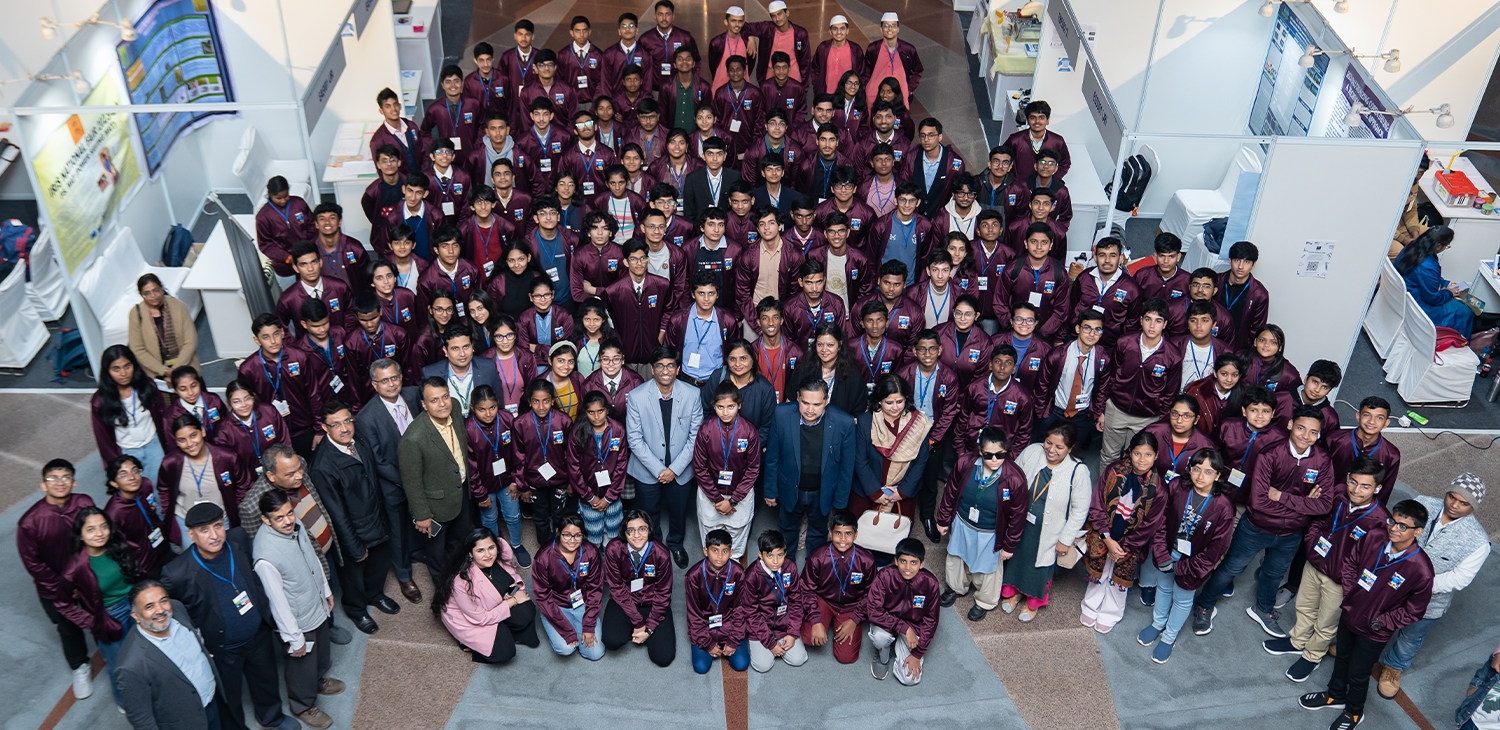
Shortlisted finalists present their projects at the IRIS National Fair in person - typically held in Bengaluru in January or February. Grand prizes and special achievement awards are announced at the closing ceremony.
What can I bring to my booth?
Sealed dried plant materials, sealed soil or liquid samples, properly shielded vacuum tubes, insulated apparatus and Class II lasers with safety signage are permitted. Living organisms, open chemicals, sharp items, taxidermy, photographs of animal surgery and any student identity disclosure are prohibited.
What facilities are provided at the booth?
Each booth has 220V, 50Hz single-phase power. Wi-Fi is available; participants should bring their own laptops if internet access is needed for the demonstration.
Will my project be displayed publicly?
Yes - the National Fair includes a public viewing day where students from other schools, sponsors and the press visit the exhibits. Your name and school are not displayed during judging but may be shared during public sessions.
06 ISEF Pathway
The road to ISEF.
How are Team India members selected?
Top performers at the IRIS National Fair are selected as Team India to represent the country at Regeneron ISEF - the world’s largest pre-collegiate science fair held annually in the United States.
Where will ISEF 2027 be held?
Regeneron ISEF 2027 will be held at the Los Angeles Convention Center, Los Angeles, California, USA, from May 8–14, 2027.
What support does Team India receive?
Selected students attend dedicated mentoring camps in New Delhi and Gurugram between March and April. Preparation covers quad charts, scientific posters, paperwork, presentation training and ISEF-specific briefings.
Has India done well at ISEF historically?
Yes - since 2006, IRIS has sent 385+ Indian students to ISEF and Team India has brought home 200+ awards. The programme also has 31 minor planets named after First and Second Grand Award winners by MIT’s Lincoln Laboratories. See the full winners archive.
Is travel sponsored?
Travel, accommodation, registration and meal support for the Team India delegation is sponsored by IRIS supporters and the Government of India. Students do not pay out of pocket for ISEF participation.
07 Other
Anything else.
When does the 2026–27 cycle open?
Registrations for the 2026–27 cycle are open from 1 August 2026 to 13 October 2026 at register.irisnationalfair.org. The cycle culminates in Regeneron ISEF 2027 at the Los Angeles Convention Center, USA, in May 2027.
Can I get a certificate of participation?
Every shortlisted finalist receives an IRIS National Fair certificate. Submissions that don’t make the shortlist do not receive certificates of participation.
Does IRIS have age limits beyond Classes 5–12?
No, there is no formal age cap - eligibility is determined solely by current class enrolment (5–12) at an Indian school.
Can my school nominate students?
Students apply individually - schools cannot nominate students directly. Teachers and schools are encouraged to support and mentor their students through the application.
Does IRIS share my data?
IRIS handles personal information confidentially. See the official privacy policy for full details on data handling and sharing.
How do I reach the IRIS team?
Email contact@exstemplar.com or call +91 93199 98713 / +91 92113 98453 (Mon–Fri, 9am–6pm IST).
Still have questions?
Drop us a line on WhatsApp or email - the IRIS team responds Monday to Friday between 9am and 6pm IST.